
The Paths that Ghosts Follow
W/ Daniela Cinel O’Fee @ The Lake Country Art Gallery, curated by Wanda Lock.


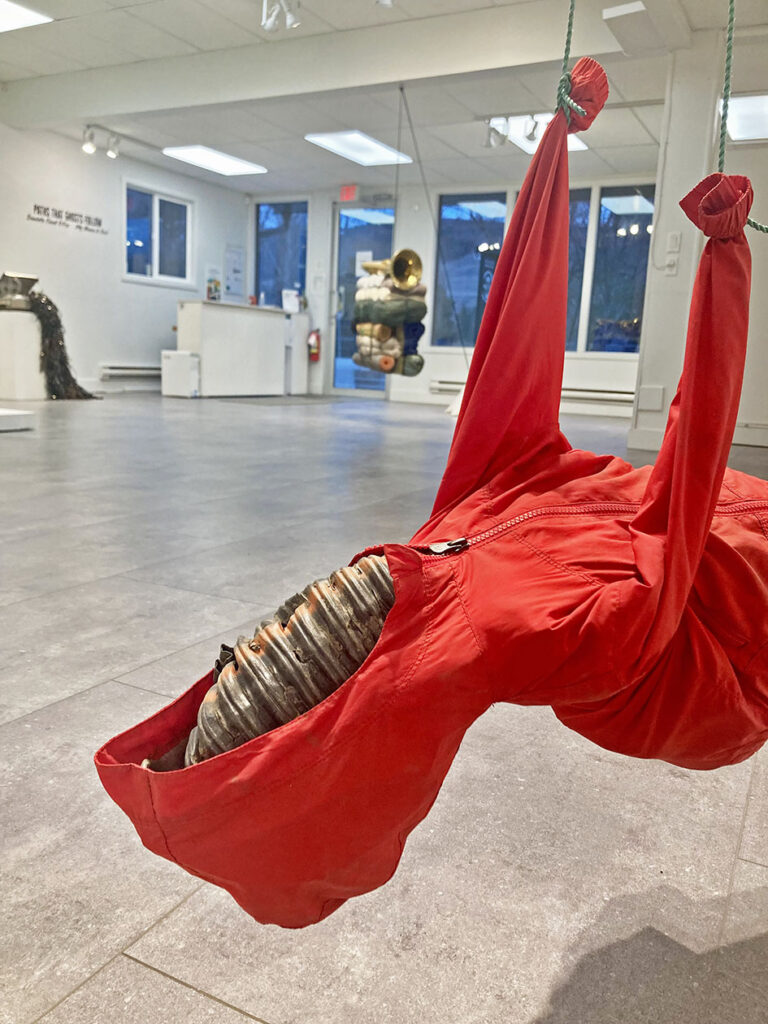
Hello All, Here’s a few images of my work from The Paths that Ghosts Follow, an exhibtion exploring ideas of existential liminality—the feeling of being caught between presence and absence, between identity and dissolution. Daniela Cinel O’Fee’s works elegantly explores the tension between displacement and adaptation, while Yours Truly’s works delve into the material residues, manufactured meanings, and emotional by-products of our late capitalist age. I’ve put together a quick textual and visual walkthrough of my work for those of you who won’t have a chance to see it in person. Any questions or comments, I’d love to hear from you! xs
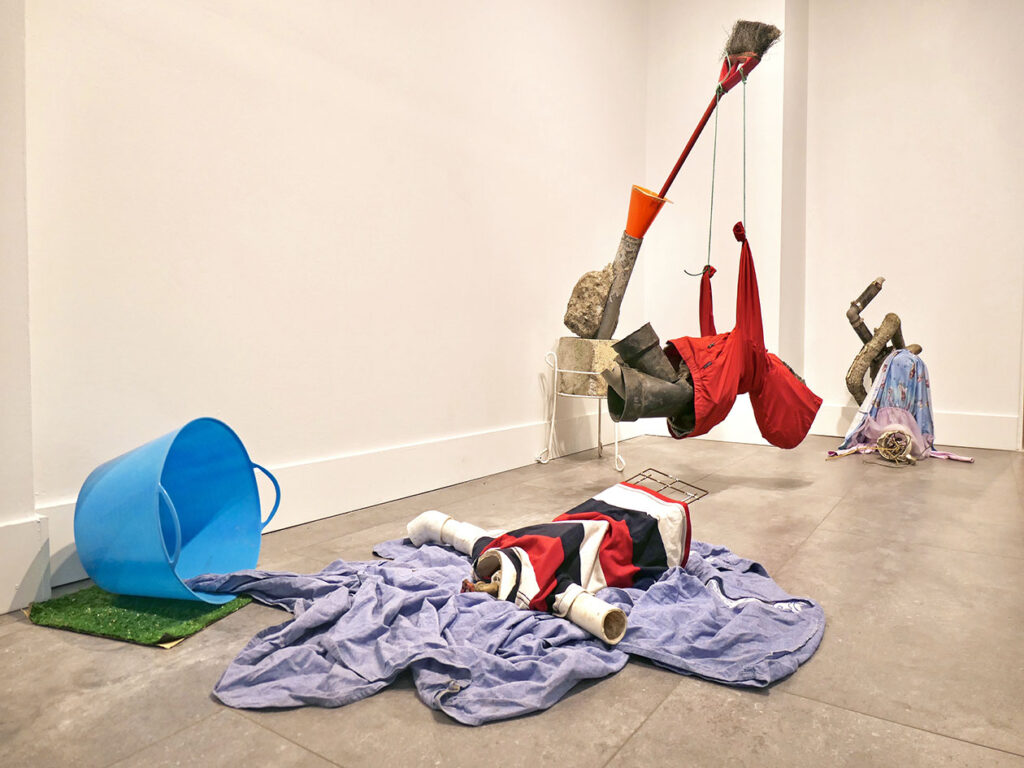
Playground
The pieces of Playground allude to the gestures and poses of children at play: a figure pumping their legs on a swing, a girl doing a cartwheel, another child playing with water. Composed of gathered remnants of pipe, wire, conduit, clothing and rubble, the figures are also suggestive of the terrors of childhood: the dangers of an uncontrollable world where monsters, both real and imaginary, disrupt or destroy joyful innocence. I suppose with Playground, I’m equating childhood with the idea of Infrastructure: that phase in our development when the building blocks of culture, morality and meaning are laid down inside us, that place where the framework for becoming an ethical and empathetic human gets fabricated. The work visually references the violence of recent global events and contemplates the stress and fear that children must feel when faced with a destabilized world. But Playground also asks us to scrutinize our adult selves, to sift through the emotional rubble that abounds in our contemporary world and commit to rebuilding the structures, protecting the places and upholding the practices that still hold true to the intrinsic promise of youth.


The Seeker, Feedback Loop, Pietà
Each of these three ‘figurative’ works plays with ideas of scale, method/material and mimicry to depict the human form and consider the ways in which individual selves or bodies may be seen or made invisible by social structures, cultural traditions or political agendas. I use a variety of approaches within the figurative works to reflect the privileges, expectations and predicaments that attach themselves to our perceived bodies. The assorted ‘figures’ alternate between doll-size maquettes, larger than life signboard cut-outs and human scale limbs cast directly from my own body to explore the structures, media or messaging platforms that surround us and potentially, challenge the ways in which the repetition of ideas, intentions, or images enhances, alters or depletes meaning.
Feedback Loop suggests a closed system where the same actions beget the same results. The text of the painting component, hand carved in drywall panel, reads: ‘Never accepted me as I am’, suggesting an inner monologue, with the crawling 3-d, sign-board figure either lamenting the inability/refusal of society to see them fairly or realistically, or perhaps, an obsessively rejecting their own self-image, as illustrated by the tiny, ‘bagged’ rendering of a crouched, almost foetal figure hiding just behind on the corner wall.
Adjacent to Feedback Loop is Pietà, an assemblage of three figures loosely based on Michelangelo’s sculpture of the same name, depicting a beseeching form and a figure deep in grief bookending a dying or dead body sprawled between them. Composed minimally of wood scraps and street waste, the figures mimic the essential gestures of despair and defeat and discretely refer to the outcomes of the ongoing opioid crisis. Pietà wonders about suffering; how our society defines an individual’s worth, determines whose dying deserves to get noticed, and values some kinds of grief more than others. The Seeker, composed mostly of shipping materials, resembles a crawling human figure with arms and legs cast from layered, waste plastics, and a recycled carry bag used to represent the torso. Are its ghostly, opaque limbs emptied of agency or alive with virtual possibilities? Is the illusory figure crawling away from an untenable past or dragging itself determinedly forward to a better future? Watching over the figure, and the room itself, is a ‘life-size’ surveillance camera made entirely of wood and hence, completely inoperable. The Seeker wonders if somewhere between the stratified surfaces and hidden spaces of our own bodies are aspects of our future selves which are migrating towards a new state of being. The defunct monitoring device suggests that when our bodies and actions are not being surveilled and scripted by social expectations, we have the potential to develop or define our own sense of self.


Selfie, Coping Mechanism, Soul Meet Body
These are all older works, box-like structures seemingly inscrutable from the outside, which rely upon the viewer to open them up to reveal meaning. Yes, they are meant to be touched and gently examined. Text tablets are housed inside each container; simple words which can be animated by the viewer’s own hand or amplified through their personal, narrative decision-making process. Selfie confronts the viewer with the concept of how they see their own constructed “I”. Coping Mechanism considers the conscious and unconscious strategies we use to confront or control our responses to our perceived reality. Perched atop a viscera coloured woolen blanket, the blandly rustic wooden box called Soul Meet Body, suggests that there are many ways to interpret or identify the containers, contexts or formats in which our spirit, or notions of self may reside.
Data Sort
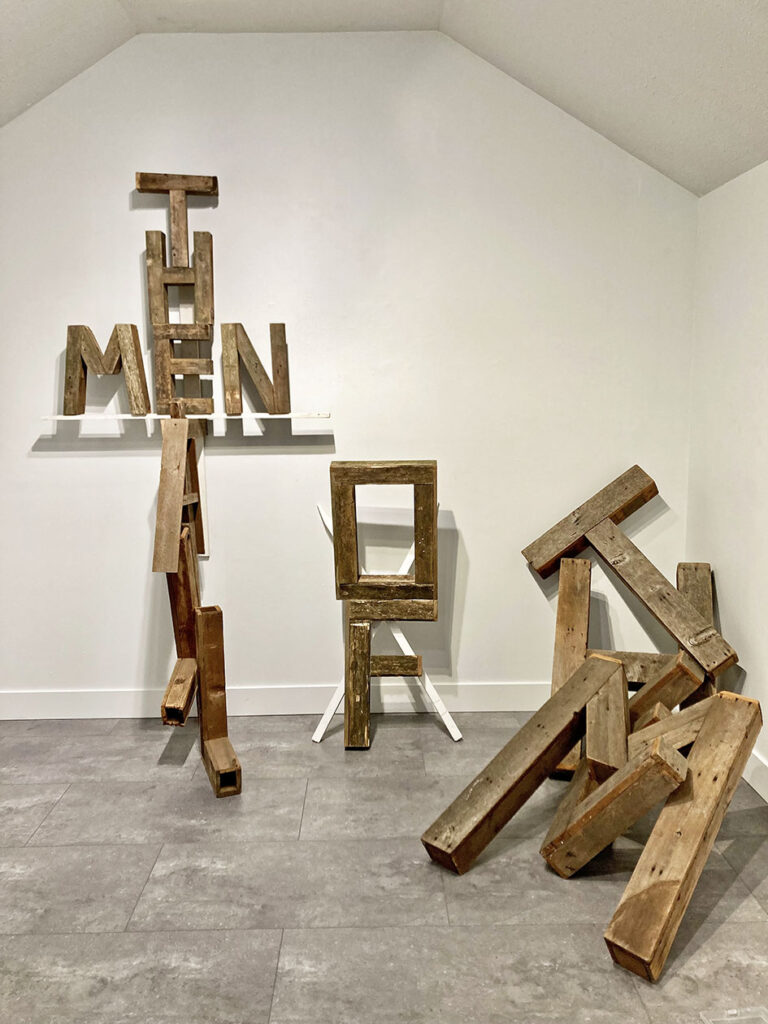
A construction of handmade, wooden letters spelling out the phrase, originally taken from a language learning book: ‘The Men All of Them’. The composition is loosely based upon Goya’s painting “Third of May”, in which the central figure of a Spanish peasant, a male, stands with arms cast out in front of a larger group of male villagers ranged against a wall as they are being gunned down by a firing squad of Napoleon’s troops. The phrase is also a summary of the command of Marc Lepine, the man behind the École Polytechnique massacre of December 6, 1989, who ushered ‘all the men’ out of the room before gunning down 14 women. Data Sort considers both historical and contemporary examples of genocide and gender-based violence. The piece questions our individual and collective complicity in dehumanization, when we use language to reduce the people standing in front of us to abstract entities or algorithmic data sets, characterizing them as unwanted ‘others’ who obstruct our economic or political ambitions, oppose our cultural prejudices or refuse to conform to our social bias’s.


Recursion, Described Video, Loss Aversion
These three works each use text to explore the inner monologues and external narratives that we use to define or defy our place in the world.
Recursion features a stack of VHS cassettes, topped by an opened case with tape spilling out, and the phrase “It Happened” stenciled upon the outside. Bookending the VHS stack on the right, is a portrait of a young woman carved into drywall, with another drywall carved panel, on the left, with a phrase etched into the surface that reads: “I can’t even remember your name”.
‘Recursion’, in its simplest definition, means to do something again, i.e., to repeat a function over and over. In computer science, recursion is the process a procedure goes through when one of the steps of the procedure involves invoking the procedure itself, while in the Social Sciences, recursion refers to the difficulty of challenging a socio-political order using the very tools that have been developed by same system one is attempting to critique. In the piece, the level gaze of the young woman in the portrait panel challenges the viewer to consider the ‘closed loop’ acceptance of our mediated narratives; those versions of our history in which prejudices, assumptions and expectations blind us to seeing others as unique individuals, forgetting the names and faces behind the headlines. In part, the piece is a response to the typecasting of the ‘Missing Women’ of Vancouver’s Downtown Eastside.
Described Video features a three-sided cardboard pillar covered with sporadic text, and a ‘fire-pit’ of real rocks, foam and faux wood nestled between two sides. The Pillar suggest a memorial or monument, the ‘fire’ an eternal flame. The text encircles the pillar, bidding the viewer to move in a spiral pattern around the structure in order to collect the words and construe meaning. The text, painted in high-vis orange looks a bit like emergency signage for navigating a crisis situation, with danger, an unspecified enemy, an unknown faction of men, and unspecified women trying to escape them. To try and decipher the details, the viewer must repeatedly circle the pillar, entering into a fugue-like state of perception, enacting a performative migration that mimics aspects of the crisis perhaps being described: the running away from/ to, the escape, the potential shelter of the cardboard structure, the respite of a symbolic fire.
‘Described video’ typically refers to a form of summarized narrative which provides key information about a mediated event for people with visual impairments or accessibility issues. In this instance, I’m adapting the phrase to invite any viewer to consider the ‘lived experiences’ that may be unfamiliar to them; to step outside their own context and ‘see’ or feel the imagined or un-imaginable situations that are all too real, for far too many people in the world. Note: The text was compiled from a notebook found abandoned on the streets, it appeared to be a dream journal, kept by a young woman with repeated dreams of fleeing from a hazardous situation. I discreetly glanced through it, borrowing some of her words and replacing the book in a sheltered spot nearby. I hope she discovered it again or at least found a safer place in her waking life.
Loss Aversion
In cognitive science, the concept of ‘loss aversion’ suggests that people will respond more strongly to losses than they will to corresponding gains. In effect, this suggests that we place more value in a negative situation than a positive one, which often results in people remaining stuck in the familiar, even if it is uncomfortable, rather than taking a chance, making a change or moving toward the unknown.
The text quoted in this piece is from The Diary of a Young Girl by Anne Frank, a documentation of her time spent in hiding during the Nazi occupation of the Netherlands. The phrase, recreated in hand-built wooden letters says, “Dead People Get More Flowers Than The Living Ones, Because Regret Is Stronger Than Gratitude” and it exemplifies the clear eyed and poignantly acute wisdom of a teenage girl coming to terms with the world while coping with circumstances well beyond her control. The shrine like structure that supports the text is bedecked with flowers, both real and fabricated and illuminated by counterfeit candles. It invokes the impromptu memorials that spring up on sidewalks or roadsides in response to an unexpected death or a collective calamity. The piece is, in part, inspired by the outbreak of opioid related deaths in my neighbourhood and the ongoing, accumulated anguish that is increasingly becoming a normalized consequence of our shrinking social infrastructures. While many of us may cling to the status quo, standing by and watching, instead of standing up and fighting, avoiding the risks to what ‘we’ have, and repulsed by the ‘have nots’, our assumed security is only as strong as the principles and practices that protect and promote the value and worth of everyone. As history and the tumult of our current times has repeatedly proven, there are no guarantees that the chaos of world will not touch us and while the temptation is to hunker down and prepare for the worst, perhaps we should be grateful that we still have the potential to strive for something better. WWAFD? (What would Anne Frank do?)
